The Short Answer
Yes, a virtual tour can help a home sell faster. But the tour isn't what sells the house. It removes the things that slow a sale down: showings with buyers who were never a fit, out-of-town buyers who can't get here in time, and second visits just to re-check the layout.
That distinction matters, because it tells you when a tour will help and when it won't. A walkable tour on a well-priced, well-photographed home shortens the path from "saw it online" to "wrote an offer." The same tour on an overpriced home just lets more people decide faster that they aren't interested.
This guide is about speed specifically. If you're still deciding whether a tour is worth the money on a given listing, our guide on whether 3D tours are worth it covers that. Here we stay on one question: what does a tour do to days on market, and why?
What the Numbers Say (and How Much to Trust Them)
The figures you'll see quoted most come from the companies that make the tours, so read them as a direction, not a promise.
Zillow has reported that listings with its 3D Home tours sold about 10% faster on average and were saved by buyers about 50% more often than listings without one. iGUIDE, the system behind our flagship tour, reports that listings with an iGUIDE sold 39% faster than listings with photos alone.
Those numbers are far apart, and that's the first clue to how to use them. Neither is a controlled experiment. Agents who order a 3D tour also tend to price carefully, hire a professional photographer, and launch with a complete listing, so some of the speed belongs to everything else they did right. Nobody can cleanly separate the tour from the agent.
What is consistent, across every source and for years now, is the direction: listings with a real walkthrough get more attention and sit for less time. The reasons below explain why that holds up even when you discount the exact percentages.
What Counts as a "Virtual Tour"
The term covers three very different things, and only one of them does the work described in this guide.
A slideshow video is your listing photos set to music. It's fine for social media, but a buyer can't steer it. It shows the same thing the photo gallery shows, in a fixed order.
A set of 360° photos lets a buyer look around from fixed spots in each room. It's better, but the rooms don't connect. The buyer still has to guess how the kitchen relates to the living room.
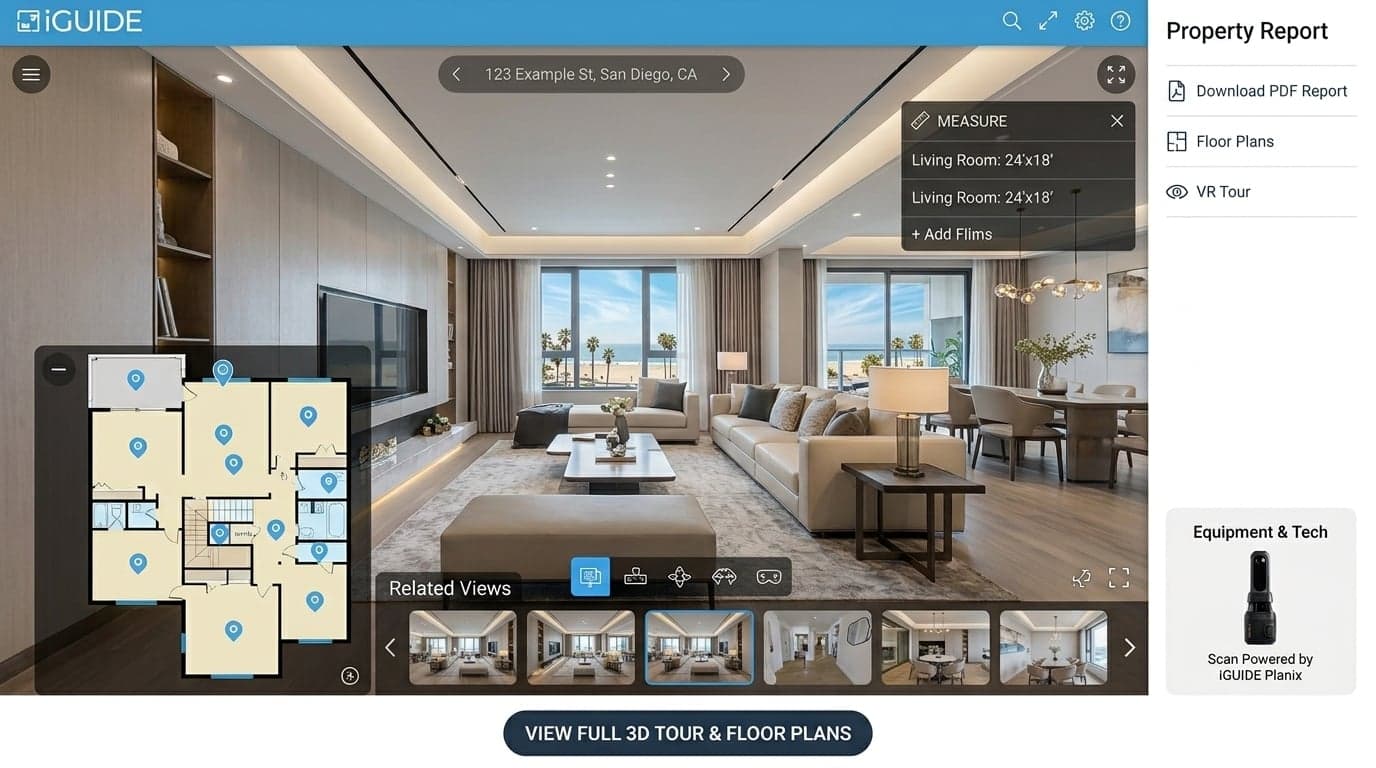
A true 3D tour lets the buyer walk the home on their own: move from room to room, turn around, go back, and check a floor plan to see where they are. iGUIDE and Zillow 3D Home tours are both in this group, and iGUIDE adds a measured floor plan with room dimensions.
When the numbers above say tours sell homes faster, they're measuring the third kind. A buyer has to be able to answer their own questions about the layout. That's what replaces a showing.
Four Reasons a Tour Shortens Time on Market
It filters buyers before the first showing. Someone who has walked the home online and still books a showing already knows the bedrooms are upstairs and the yard is small. They aren't coming to find out whether the layout works. They're coming to confirm they want it. Fewer of your showings are wasted, and more of them end in an offer.
It lets distant buyers act. San Diego draws a steady stream of buyers who aren't here yet: military families on orders to Camp Pendleton or the Navy bases, people relocating for work, and out-of-state buyers. Many of them have a week, not a month. A walkable tour is their first showing, and sometimes their only one before they write.
It cuts the second visit. A lot of time between a first showing and an offer goes to "can we see it again?" Usually that's about remembering the layout or checking whether the furniture fits. A tour with a floor plan and room dimensions answers those from the couch that night.
It makes the listing easier to find and keep. On Zillow, buyers can filter for homes with a 3D tour, and buyers who explore a tour are more likely to save the listing and come back. A saved listing is a buyer who gets notified when anything changes, which is the audience you want watching.
What a Tour Can’t Fix
A tour speeds up a sale that was going to happen. It doesn't create one.
Price. An overpriced home with a beautiful tour is still overpriced. The tour may even make that clear sooner.
Weak photos. The photos earn the click. If the lead image doesn't stop the scroll, nobody reaches the tour. A tour is the second step, never a replacement for the first.
A home that isn't ready. A 3D tour shows everything, in every direction. Photos can frame around a cluttered corner. A tour can't. If the home isn't prepped, a tour will show buyers exactly what you were hoping they'd overlook.
A layout that works against the home. If the floor plan is the weakness, a tour shows it honestly. That's still better than buyers discovering it in person, because the ones who visit have already accepted it. But it won't turn a difficult layout into a selling point.
Launch With It, Don’t Add It Later
A new listing gets most of its attention in its first few days, when it reaches every buyer with a saved search in that area. That window doesn't come back.
If the tour goes up a week after the listing does, the buyers who looked in week one saw the home without it, and many of them have already moved on. The speed benefit depends on the tour being there when that first wave arrives.
So plan it into the shoot, not after it. We capture the 3D tour in the same visit as the photos and deliver both the next day, so the listing can go live complete. If your current workflow has the tour arriving days after the photos, that delay is costing you most of what you paid for.
Where to Put the Tour So Buyers Actually Use It
A tour nobody opens does nothing. A few placements make the difference.
Put the link in the MLS virtual tour field, so it carries through to the sites that pull from the MLS.
For Zillow, use a Zillow 3D Home tour, which shows directly on the Zillow listing. Since Zillow stopped showing Matterport tours in late 2025, this is the reliable way to have a walkthrough on Zillow itself. Many agents pair it with an iGUIDE for the MLS and everywhere else.
Add the floor plan image to the photo set. Buyers who won't open a tour will still look at a floor plan, and it sends some of them to the tour.
Send the tour link in your reply to every inquiry, and again after every showing. "Here's the walkthrough so you can look again tonight" is the easiest follow-up you'll ever write.
Put it on the open house sign-in and the flyer with a QR code, so visitors can re-walk the home when they're comparing it to the others they saw that weekend.
The San Diego Case for It
Two things about this market make a tour count for more than the national averages suggest.
First, the share of buyers shopping from somewhere else is high, and they move on a schedule. A listing they can walk online is a listing they can act on.
Second, most listings still don't have one. When we checked active listings across six coastal San Diego ZIP codes in June 2026, only about 13% included a 3D tour. In a search result where nearly nine in ten homes offer only photos, the one with a walkthrough is the one a rushed buyer can evaluate tonight.
If you're listing a home with any distance between it and its likely buyer, whether that's miles or just a busy week, a tour is one of the few things you can add that works on the calendar directly.
Launch complete on day one
Add a 3D tour to your shoot, delivered next day with the photos.